Dog Struggling with Stairs? What to Change at Home (and What It Might Mean)
Advertising disclosure: this article may contain affiliate links. We may earn a commission at no extra cost to you. It never changes our advice. How we fund our work
He used to take the stairs two at a time. Now he stands at the bottom, looks up at you, and waits. Or he goes up fine and won't come back down. Either way, the staircase has become a negotiation.
Stairs are usually the first place an aging body shows itself. That's information, if you can read it.
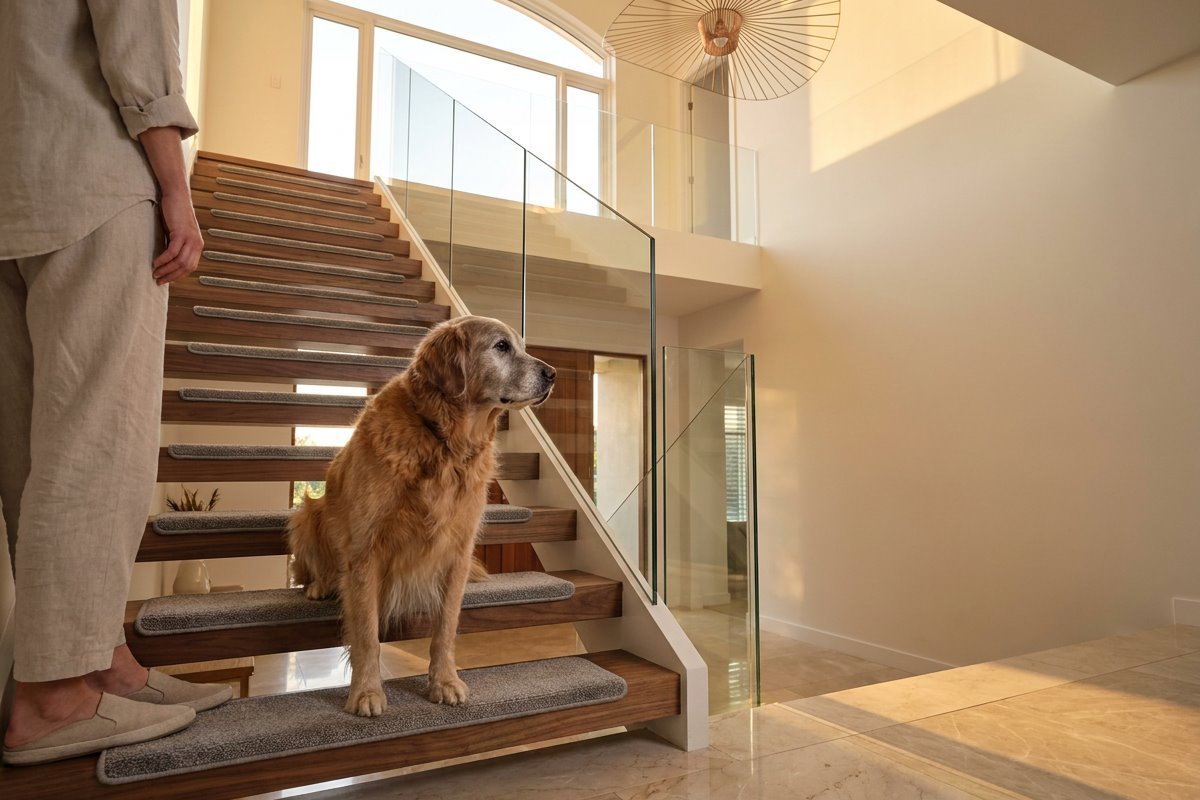
Trouble going up tends to point to the hind end: hips, knees, or lower back. Trouble going down tends to point to the front legs, the eyes, or a scare after a slip. Either way, three changes help now: grip on every step, light at night, and help that spares his spine. Sudden refusal, dragging feet, or crying out is a vet call today.
Why stairs are often the first thing to get hard
A hallway asks a dog to swing his legs forward. A staircase asks him to fold each joint deeper, push his full weight up one leg at a time, then catch it on his front legs on the way down. It's the hardest thing most house dogs do all day, so a sore joint shows up here first. Whether this is age or pain is covered in signs your dog is slowing down.
Going up vs. going down: what each one can point to
Owners say "he's bad on the stairs." Vets ask which direction, because the two lean on different parts of the body.
Trouble going up
Climbing is a hind-end job: each step is a small push-up from the back legs. A dog who slows, pauses, or bunny-hops on the way up (both back legs moving together) tends to be protecting hips, knees, or lower back. Cornell's Riney Center lists reluctance to climb stairs among the signs of osteoarthritis, and VCA calls bunny hopping a classic sign of hip dysplasia. A torn cruciate ligament often shows as one back leg being spared.
Trouble going down
Going down flips the load. Dogs carry about 60% of their weight on their front legs, a figure Dr. Leilani Alvarez cites in dvm360, and descending piles more onto them, because the front legs are the brakes. A dog with a sore elbow or shoulder may climb fine and freeze at the top.
Two other causes aren't joints at all. Vision: a lens clouding with age or cataracts blurs one step into the next in dim light; VCA notes owners often notice cataracts first as hesitation in unfamiliar settings. Memory: one slip on a bare step can be enough for a dog to decide the stairs aren't safe. He isn't stubborn. He's reasonable.
Suddenly refusing both
Gradual is one story; sudden is another. A dog fine on Monday who won't touch the stairs on Wednesday can suggest something acute: a disc problem, a fresh injury, or, with a head tilt or stumbling, a balance problem. The Merck Veterinary Manual lists intervertebral disc disease as a common cause of back pain and hind-limb weakness that comes on fast.
| What you see | It can point to | What to do first |
|---|---|---|
| Slow or bunny-hopping going up | Hips, knees, or lower back | Film it; book a vet visit |
| Fine going up, balks at the top | Front legs or eyesight | Add light and a marked edge; tell the vet |
| Skips one back leg on the climb | One sore joint, often the knee | Rest from stairs; vet visit within days |
| Hesitates only at night | Vision | Night-light; ask for an eye check |
| Rushes down, can't seem to brake | Front-end pain or a weak hind end | Block the stairs; support harness |
| Sudden refusal with wobbling or dragging | Spine or nerves | Same-day vet call; carry, don't coax |
Small dogs vs. big dogs on stairs
A standard step is about seven inches tall: a stride for a Labrador, roughly the length of a Chihuahua's leg. For a small dog, every step is closer to a jump.
Long-backed, short-legged breeds (Dachshunds, Corgis, Basset Hounds, French Bulldogs) have a second reason for caution: Cornell's Riney Center notes they're predisposed to intervertebral disc disease, and repeated jumping down loads the spine the wrong way. For these dogs, blocking the stairs and carrying them is standard advice.
Big dogs have the opposite problem. You can't carry a 90-pound dog with a bad hip, and trying is how owners hurt their backs. For a large senior, it's a support harness, one-floor living, or both.
A step-by-step stair safety check
Most of what makes a staircase dangerous for an older dog can be fixed in an afternoon.
Traction on every step
Bare wood and tile are the enemy: a slipping back foot is how a sore hip becomes a fall. Carpet stair treads with adhesive backing or tacks put grip where his paws land. Also trim the fur between the paw pads and keep nails short.
Light
Older eyes need more light and more contrast. A night-light at the top and bottom of the stairs solves most evening hesitation. If his vision is fading, contrasting tape along the nose of each step gives him an edge to aim for.
The top and the bottom
A gate at the top has to be screwed into the wall or banister, never pressure-mounted. The federal safety standard for child gates (16 CFR Part 1239, which adopts ASTM F1004) is built around that rule: pressure-mounted gates carry a warning against use at the top of stairs, because a lean can pop them loose. That's a standard for children, not dogs; the physics is the same, so we borrow the logic. At the bottom, a non-slip rug gives him a grippy landing.
Outdoor steps and deck stairs
Porch and deck stairs are often steeper, wetter, and worse lit than anything inside, and open-riser stairs are hard for a dog with poor depth perception. Add treads with grit, check for loose boards, and consider a motion-sensor light. For a few steps to the yard, a ramp is almost always better.
Should you block the stairs? Setting up one-floor living
Sometimes the right answer is to stop the stairs, at least until your vet has weighed in. Move water, food, and bed to the floor where you spend your days. The hard part is nighttime: a dog who has slept beside your bed for ten years won't accept the living room quietly. Two options: a second bed downstairs and one of you sleeping there for a few nights, or, for a dog you can lift, one carry up at bedtime and one down in the morning. One carry a day is a different load than ten unsupervised trips.
How to help your dog on the stairs safely
Using a support harness
A support harness is a padded sling or full-body harness with a handle over the back. You take a share of his weight as he climbs, so a weak hind end gets an assist without you lifting him. It suits medium and large dogs who can still move their legs, not a dog who can't bear weight. The front strap belongs behind the front legs, never across the throat.
How to carry a dog without hurting his back
Never lift a dog by the front legs or under the armpits alone; that hangs his spine like a hammock. One arm behind the front legs, across the chest, the other under the hindquarters, so chest and rear come up together and the spine stays level. For a Dachshund or any dog with a disc problem, this is the only way to carry him.
When a ramp makes more sense than stairs
For the car, the couch, and porch steps, a ramp removes the drop that punishes sore joints. For a full indoor staircase, a ramp gentle enough would fill the hallway.
An honest note: there is no veterinary standard for ramp slope. The 1-in-12 slope (about 4.8 degrees) is the ADA standard for wheelchair ramps; the 18-to-22-degree range comes from ramp manufacturers, not a study. The real test is your dog: if he walks it without hesitating at the start or speeding up at the bottom, the angle is right. If he balks or scrambles, it's too steep.
Stair red flags: call your vet
🚨 Same day
- Can't get up, or sudden weakness in the hind end
- Dragging the back feet, or walking on the top of the paw (knuckling)
- Crying out on the stairs, or when you touch his back
- Loss of bladder or bowel control
- Fell on the stairs and is limping or in pain
- Sudden refusal with a head tilt, stumbling, or disorientation
⚠️ Within a few days
- Refusal that appeared over days or weeks
- "Bunny hopping" up with both back legs together
- Missing or tripping on steps
- Rushing down, unable to brake
- Hesitating only at night or in dim light
The full list of signs is in signs your dog is slowing down.
What comes next
Once the stairs are safe, talk to your vet about pain control. The AAHA pain management guidelines treat chronic pain as something to look for in every senior, not to wait out. Exercise for stiff joints, supplements, and the right bed are topics we'll cover separately.
Frequently asked questions
Are stairs bad for older dogs?
Not by themselves. A senior dog with sound joints can use stairs for years. They become a problem when they're slippery, or when pain, weak back legs, or failing eyesight turn each step into a gamble. Fix traction and light first, then let your vet decide whether stairs stay in his routine.
Should I carry my dog up and down the stairs?
If he's small enough to carry safely, yes, once a refusal or slip has happened, until a vet has looked. Support his chest and hindquarters together so his spine stays level. For a dog too heavy to lift, a support harness or moving his bed and bowls downstairs is safer for both of you.
Is going down stairs harder than going up for dogs?
Often, yes. Dogs carry roughly 60% of their weight on their front legs, and going down loads them even more, because they do the braking. Add a step he can't see well and a hard landing, and descending asks more of an older dog than climbing, which is why refusal so often starts there.
Is a ramp better than stairs for a senior dog?
For a car, a couch, or porch steps, a ramp is usually easier on the joints because it removes the drop. For a full indoor staircase, it's rarely practical: there's no veterinary standard for slope, and a long, steep ramp can be harder than the stairs. The real test is whether your dog walks it calmly.
Why is my old dog suddenly scared of the stairs?
Sudden fear tends to have a cause: a slip he remembers, a step he can't see clearly in dim light, or pain that appeared quickly. Dogs don't decide to be dramatic. A refusal that came on over a day or two, especially with wobbling or a head tilt, is a same-day call to the vet.
Sources
- Cornell Riney Center — Osteoarthritis
- Cornell Riney Center — IVDD
- VCA — Arthritis
- VCA — Hip Dysplasia
- VCA — Cruciate Ligament Rupture
- VCA — Degenerative Myelopathy
- VCA — Cataracts
- Merck Veterinary Manual — Spinal Column and Cord Disorders
- AAHA — 2022 Pain Management Guidelines
- dvm360 — The Diagnostic Puzzle of Canine Forelimb Lameness
- eCFR — 16 CFR Part 1239 (Gates and Enclosures)
- ADA — 2010 Standards for Accessible Design