Signs Your Dog Is Slowing Down — and What's Actually Normal
Advertising disclosure: this article may contain affiliate links. We may earn a commission at no extra cost to you. It never changes our advice. How we fund our work
Somewhere between "he's just older" and "something is wrong" there's a gray zone most owners live in for months. The walk got shorter. He thinks twice before the stairs. And then the question underneath it: am I being paranoid, or am I being negligent?
Both mistakes happen. One is far more common.
Some slowing down is normal after a dog's seventh birthday or so. But pain is never a normal part of aging. The useful test isn't whether your dog is slower — it's how: stiffness that eases as he warms up, weakness that gets worse the more he moves, changes that showed up over weeks rather than years. Those patterns separate "just age" from "needs a vet."
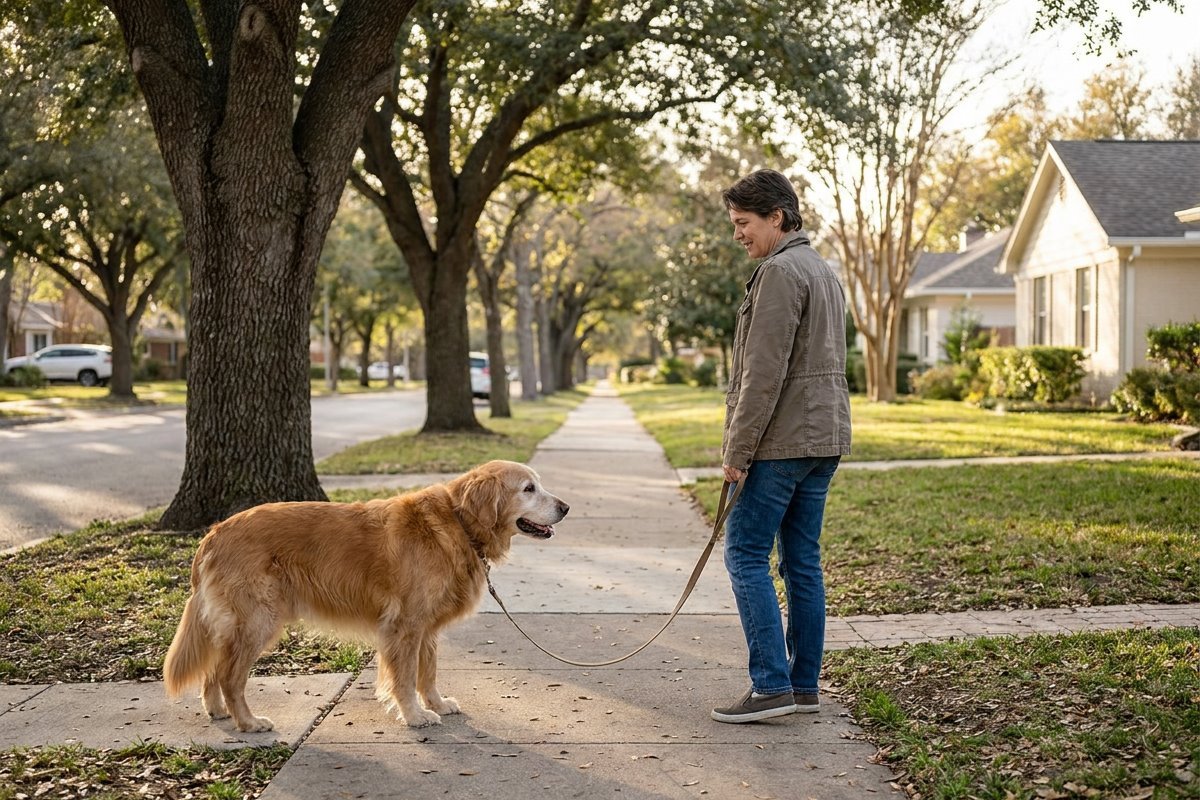
The question every owner is really asking
One number reframes the whole thing. Researchers estimate that between 14% and 22.5% of dogs over eight show signs of cognitive decline. Only about 1.9% ever get a formal diagnosis. That gap is owners, and sometimes clinics, filing the changes under "getting old" and moving on.
Joint pain follows the same script. Cornell's Riney Canine Health Center describes osteoarthritis as one of the most common conditions in older dogs and among the most under-recognized, because the picture people expect — limping, crying out — is rarely what a dog in chronic pain does.
So the real risk isn't paranoia. It's months of a treatable problem written off as a birthday.
What normal aging actually looks like
Not every gray muzzle needs a workup. It helps to know what aging should look like so you can spot what doesn't fit.
Changes you can expect after age seven
- More sleep, but easy to wake. He still gets up for dinner, the doorbell, and you.
- Gray hair around the muzzle and eyes, and a thinner or coarser coat.
- A slower pace on walks. He's happy to go; he just isn't pulling.
- A bit less muscle over the back and hind end, lost slowly.
- Cloudy-looking eyes. A bluish haze in the lens is common; a vet can tell it from cataracts in seconds.
The common thread: gradual, mild, and he still loves the same things, just at 80% speed.
Why small dogs and big dogs slow down at different ages
Seven is old for a Great Dane and barely middle-aged for a Yorkie. Veterinary guidelines define "senior" as the last quarter of a dog's expected lifespan, so a large breed gets there around seven or eight while a small breed may not until ten or twelve. A Labrador slowing at seven is on schedule. A Chihuahua slowing at seven is early, and early is a reason to look closer. The brackets by size are in when a dog is considered senior.
Normal aging vs. a sign of pain: side by side
| What you see | Probably just age | Worth a vet visit |
|---|---|---|
| Slower on walks | Same route, easier pace, still eager | Stops partway, lags, or refuses a route he loved |
| Stiff getting up | A few seconds, then moves normally | Stiff for minutes, or never loosens up |
| Hesitates at stairs or the car | Slower, but still does it on his own | Refuses, needs lifting, or bunny-hops with both back legs |
| Sleeps more | Naps more, wakes easily, settled at night | Restless or pacing at night, then sleeping all day |
| Grumpy when touched | A little less patient, no particular spot | Flinches, growls, or moves away when one area is handled |
| Weight change | Stable, or slow gain with less activity | Losing weight on the same food, or a swollen belly |
| Less responsive to his name | Slower to look up, still comes | No response, startles easily, seems lost in familiar rooms |
| Accidents indoors | None | Any, after years of being house-trained |
If anything in the right-hand column is there, book the appointment. Not because it's certainly serious, but because you can't tell from the couch.
The stiffness test: better or worse with movement?
If you take one tool from this page, take this one. Watch the first five minutes of a walk and ask: is he getting better or worse as he goes?
Better with movement — stiff on the first steps, then loosening up as he warms — is the signature of osteoarthritis. The joint is sore after rest and motion eases it. It's the most common pattern in senior dogs: treatable, but it won't improve on its own.
Worse with movement is a different conversation. A dog who starts fine, then tires fast, sits down, coughs, or goes weak behind isn't dealing with a stiff joint. That points toward the heart, the lungs, or the nervous system — problems that don't loosen up because they aren't mechanical. See a vet soon, not at the next annual.
Stiff at the start and never improving can mean the arthritis has progressed, or something is going on in the spine. Either way, it's past wait-and-see. And it gives your vet something more specific than "he's slower."
Seven slowdowns that aren't just age
Arthritis
The big one. Limping, the sign most people wait for, is often the last to show up. A dog with pain in both hips doesn't limp, because there's no good leg to favor. He shortens his stride, shifts his weight forward, stops jumping on the bed, and gets quieter. Pain doesn't always make noise; vocalizing usually means acute pain, not the ache of a worn joint.
Dental pain
Easy to miss because it looks like pickiness. A dog with a cracked tooth or gum disease chews on one side or drops kibble. Breath that's gotten noticeably worse is a real sign. Chronic mouth pain wears a dog down.
Heart and breathing
Heart disease often shows up first as exercise intolerance: the same walk, but he tires halfway. A soft cough at night and faster breathing at rest are worth mentioning. Small breeds are prone to valve disease, and its early stage looks a lot like "he's getting older."
Thyroid and metabolic disease
Hypothyroidism is a classic slowdown mimic: weight gain without eating more, a dull coat, low energy. Other metabolic conditions run the opposite way: drinking and urinating far more, losing weight while eating well. Both show up on a senior blood panel.
Vision and hearing loss that looks like slowness
A dog who can't see well at dusk stops wanting evening walks. A dog who can't hear doesn't come when called and startles when touched. Both get read as stubbornness, and both make a dog more cautious. A routine exam catches them.
Cognitive dysfunction
Canine cognitive dysfunction syndrome (CCDS) is canine dementia. Vets screen for it with DISHAA: Disorientation, social Interactions, Sleep-wake cycles, House-soiling, Activity, and Anxiety. In December 2025, a working group led by NC State's College of Veterinary Medicine, with the AKC Canine Health Foundation, published the first formal guidelines for diagnosing and monitoring CCDS. Pacing at night, standing in corners, forgetting routines: that's a screening question, not a fact of life.
Medication side effects
If your dog started something new recently — a pain medication, an allergy drug, a steroid — and the slowdown followed, say so. Sedation, weakness, and appetite changes are known side effects of several common drugs, and a dose adjustment can be all it takes. Don't change anything on your own; bring the bottle.
Red flags: when to call your vet today
🚨 Emergency — same day
- Collapse, fainting, or can't get up
- Trouble breathing, panting at rest, or pale or bluish gums
- Swollen, hard belly with unproductive retching
- Dragging the back legs, or sudden weakness in the hind end
- A seizure, or sudden disorientation
- Unable to urinate
- Refusing all food and water for more than 24 hours
⚠️ Call within a few days
- Slowness that showed up over days or weeks, not months
- Coughing, or tiring much faster on the same walk
- Drinking and urinating a lot more than usual
- Weight loss with no change in food
- Restless at night, sleeping heavily all day
- Accidents indoors after years of being house-trained
- Strong bad breath, or chewing on one side only
- Stiffness on rising that does not ease after warming up
- Any limp, even one that comes and goes
What to write down before the vet visit
A vet gets twenty minutes with a dog who, in the exam room, is too nervous or excited to show anything. What happens at home is the real data. Write down:
- When it started, and whether it came on over days, weeks, or months.
- The stiffness test result: better or worse with movement.
- What he's stopped doing: the couch, the car, the long loop.
- Appetite, thirst, and bathroom changes, even small ones.
- Every medication and supplement, with doses and start dates.
The 30-second video that helps your vet most
Film your dog getting up from lying down, then walking away from you and back, on a non-slip surface, from the side. Dogs routinely walk perfectly in a clinic and hobble at home; a clip of the real thing beats any description. Shoot another in a month, because change invisible day to day is obvious across two clips.
Questionnaires your vet may use
The Helsinki Chronic Pain Index is an 11-question owner questionnaire that scores mood, willingness to move, and ease of getting up. LOAD (Liverpool Osteoarthritis in Dogs) is a similar scale. And COAST lets your vet stage arthritis from 0 to 4. Answer honestly, not optimistically. That's how decline gets measured instead of guessed at.
What you can change at home
None of this replaces a diagnosis. But once your vet has looked, these changes make an older dog's day easier, with nothing specific to buy.
- Weight. The biggest lever you control. Every extra pound sits on joints that already hurt. Ask your vet for a target weight.
- Traction. Hardwood and tile punish a weak hind end. Rugs or runners on the paths he actually uses prevent slips.
- A ramp or step for the car and the couch, so he's not landing on sore joints.
- Shorter, more frequent walks instead of one long one. Motion helps arthritic joints; exhaustion doesn't.
- A supportive bed, thick enough that his hips aren't on the floor through it, away from drafts.
Frequently asked questions
At what age do dogs start slowing down?
It depends on size. Large and giant breeds often start slowing around six to eight, medium breeds around nine, and small breeds closer to ten or twelve. Senior means the last quarter of expected lifespan, so the same birthday means different things for a Great Dane and a Chihuahua.
Is it normal for my dog to slow down at eight years old?
For a large or giant breed, mild slowing at eight is on schedule. For a small breed, eight is early, and early deserves a closer look. Normal means gradual: a slower pace, more naps, still eager for what he loves. Stiffness or changes that arrived over weeks aren't normal at any age.
How can I tell if my dog is in pain or just getting old?
Watch how he moves, not how much. Stiffness that eases as he warms up, hesitation at stairs, a shortened stride, flinching when touched, and a quieter mood all point to pain. Dogs with chronic pain rarely cry out or limp. Pain is never a normal part of aging; if unsure, let a vet check.
Why is my dog suddenly slowing down?
Sudden is the key word. Normal aging happens over months and years, not days. A fast change points to something specific: pain, a heart or breathing problem, an infection, a metabolic issue, or a medication side effect. Get it seen within days, or the same day if he can't get up or breathe well.
Why does my senior dog sleep so much?
Older dogs genuinely need more rest. A senior who naps more but wakes easily and still enjoys walks and meals is showing a normal pattern. The one to watch sleeps heavily all day and paces at night. That reversal can signal pain or cognitive dysfunction, so raise it with your vet.
Is my dog slowing down, or is he dying?
Most of the time, slowing down is not the end. It's age, pain, or a treatable condition that hasn't been found yet. Dying looks different: a dog who stops eating and drinking, withdraws, can't get up, or struggles to breathe. If you're asking this, please call your vet. It's not a question for a search engine.
Should I take my older dog to the vet just for slowing down?
Yes. Slowing down is one of the most common reasons a senior dog should be seen, and one of the most under-reported. Guidelines already recommend twice-yearly exams for seniors; a new change in mobility or energy is a reason to move the next one up. A visit that finds nothing costs an hour.
Sources
- AAHA — 2023 Senior Care Guidelines for Dogs and Cats (PDF)
- AAHA — Managing Cognitive Dysfunction (DISHAA)
- Cornell Riney Center — Osteoarthritis
- Cornell Riney Center — Aging
- Merck Veterinary Manual — Routine Health Care of Dogs
- VCA — Senior Pet Cognitive Dysfunction
- Texas A&M — The Signs of an Aging Dog
- NC State — Guidelines for Canine Cognitive Decline
- AKC Canine Health Foundation — First-Ever CCDS Guidelines
- PubMed — Helsinki Chronic Pain Index
- PubMed — LOAD questionnaire