Counterconditioning, Explained Without the Jargon
Advertising disclosure: this article may contain affiliate links. We may earn a commission at no extra cost to you. It never changes our advice. How we fund our work
Every serious dog behavior plan you will ever be given rests on the same technique. It has an ugly name, it takes ten minutes a day, and almost everyone who tries it without instructions gets one crucial detail backwards.
Counterconditioning means changing how your dog feels about something by pairing it with something excellent. The scary thing appears, good food happens. Repeat enough times, far enough away that your dog is not frightened, and the trigger stops predicting danger and starts predicting chicken. The order is the whole technique: trigger first, food second — never the reverse.
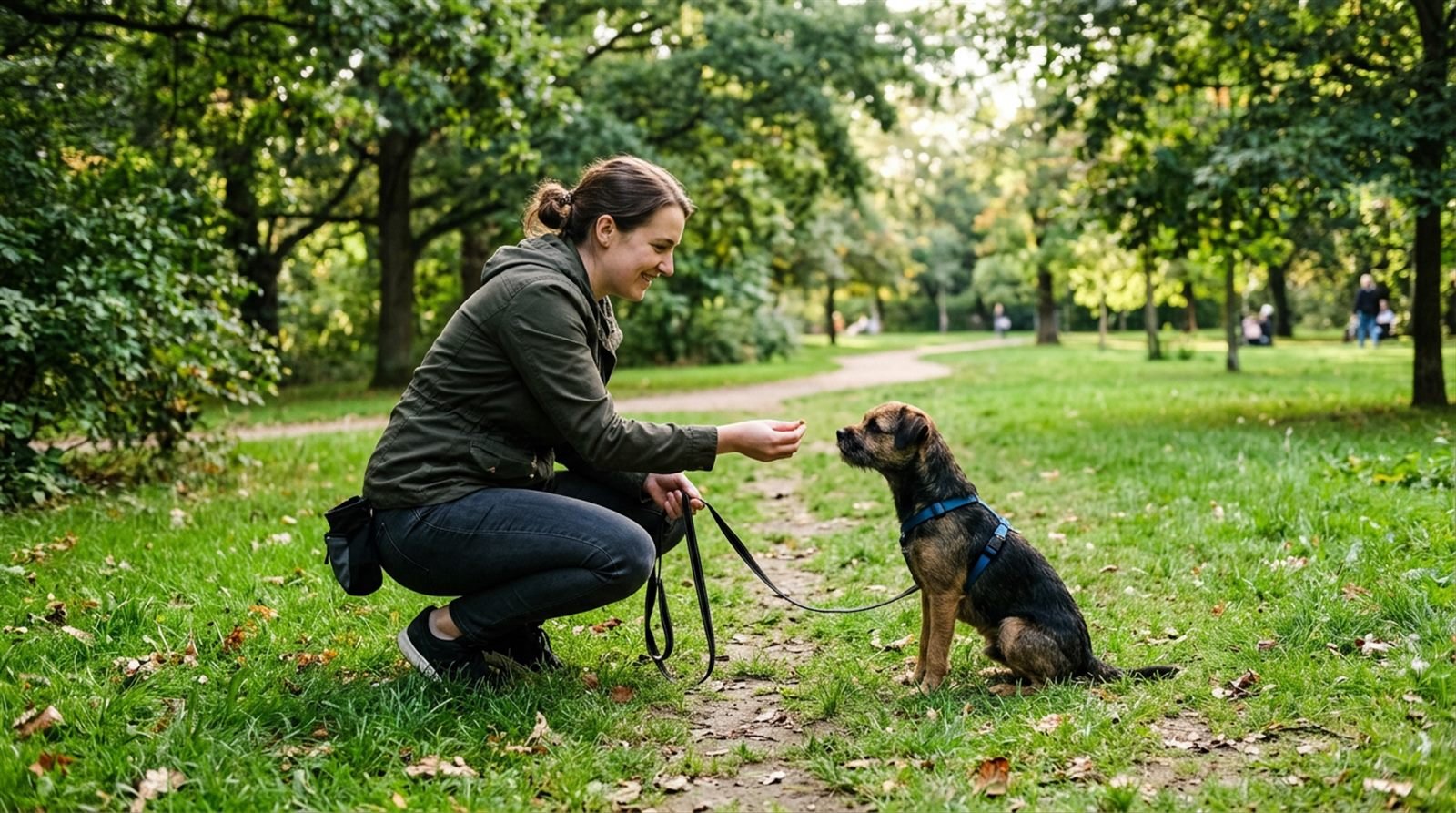
The two halves, and why they travel together
Desensitization is exposure at a strength that does not frighten your dog, increased gradually. A dog that is scared of other dogs at ten feet may be entirely fine at eighty. Eighty feet is where you start.
Counterconditioning is what you do at that distance: you pair the sight of the trigger with something the dog genuinely loves, so the emotional response gets rewritten.
Neither works well alone. Exposure without the good association is just repeated stress. The good association without controlled distance is a dog too frightened to eat. Professionals run them together and abbreviate the pair as DS/CC.
The mistake almost everyone makes
The order.
It has to be: trigger appears → food appears. The dog sees the other dog, and only then does chicken start.
What people do instead is reach for the treat pouch when they spot trouble coming, and start feeding before the dog has noticed anything. Now food predicts the scary thing. You have spent three weeks teaching your dog that chicken means a dog is about to appear — and in some cases you make the treat pouch itself a source of worry.
Feed after the trigger, stop when it leaves. That gap is doing the work.
Threshold: the number that governs everything
Threshold is the point where your dog stops being able to think. Below it, learning happens. Above it, nothing does — a frightened brain is not taking notes.
You do not have to guess where it is, because dogs tell you. Can your dog eat? That single test covers most of it. A dog that takes food, chews it, and looks back at you is under threshold. A dog that spits food out, ignores it, or takes it hard enough to catch your fingers is over.
Other tells: a stiff body, a hard stare it cannot break, a tail carried unusually high or low for that dog, sudden inability to respond to a cue it knows perfectly well.
The ASPCA's guidance is direct about the consequence of ignoring this — pushed too fast, the procedure backfires and the animal becomes more frightened than before. Going slower is not being soft. It is the difference between the technique working and the technique making things worse.
Your first session tonight
Pick the easiest possible version of your dog's trigger. Not the real thing — the faintest version of it you can arrange.
- Get the food right. Small, soft, clearly better than dinner. Chicken, cheese, whatever your dog would cross a room for. Twenty pieces ready in a pocket.
- Set the distance. Far enough that your dog notices the trigger and can still eat. If in doubt, double it.
- Wait for the notice. The moment your dog clocks the trigger — ears, head turn, brief stare — start feeding.
- Keep feeding while it is there. Steadily. This is not a reward for a behavior; it is a pairing.
- Stop the instant it is gone. The contrast is the lesson: trigger present, wonderful things; trigger gone, ordinary life.
- Finish early. Three to five good repetitions and stop. Sessions that run long end badly.
Ten minutes, three or four times a week, beats an hour on Sunday. Frequency builds associations; duration mostly builds fatigue.
How you know it is working
The change you are looking for is small and easy to miss. At some point your dog will see the trigger and look at you — a quick glance, as if to say the chicken is due. That glance is the whole technique landing. It means the trigger now predicts something good.
When it happens reliably at your current distance, close the gap slightly. Not by half. By a step or two, and hold there for several sessions.
What to expect, honestly
Progress is not linear. Nearly everyone hits a plateau somewhere around the third week and concludes it has stopped working. It usually has not — the dog is consolidating, and the next visible jump comes after it. We cover the realistic timelines here.
Expect bad days. A dog that was fine at twenty feet on Tuesday may need forty on Thursday because it slept badly, the street is narrower, or the other dog stared. Adjust the distance and carry on. That is not regression; that is a threshold that moved.
When you need a professional in the loop
The technique is simple to describe and genuinely tricky to execute — the ASPCA says as much. If there is any bite history, if the trigger is people or children, or if you cannot find a distance where your dog can eat, work with a veterinary behaviorist (DACVB) or certified behavior consultant. Some cases also need veterinary support so the dog can stay under threshold long enough to learn anything at all.
Frequently asked questions
What is the difference between desensitization and counterconditioning?
Desensitization is exposing the dog to a weak version of the trigger and increasing intensity gradually. Counterconditioning is pairing that trigger with something the dog loves so the emotional response changes. They are almost always used together, which is why professionals abbreviate the pair as DS/CC.
Am I rewarding my dog for barking if I feed during counterconditioning?
No, provided you feed when the dog notices the trigger rather than after it reacts. Counterconditioning changes an emotional association rather than reinforcing a behavior. If your dog is already barking, you are too close and should increase distance instead.
How long does counterconditioning take to work?
Mild cases often show change within two to four weeks of short daily sessions. Long-standing fears take months. Progress is rarely linear and a plateau in the middle is normal rather than a sign of failure.
What treats work best for counterconditioning?
Something clearly better than everyday kibble — small pieces of chicken, cheese or similar. The food has to be valuable enough to compete with the trigger, and small enough to deliver many repetitions without filling the dog up.