Why Is My Dog Reactive on Leash? The Real Reason Behind the Lunging
Advertising disclosure: this article may contain affiliate links. We may earn a commission at no extra cost to you. It never changes our advice. How we fund our work
You see the other dog before your dog does. You already know how the next eight seconds go — the freeze, the hard stare, then a startling amount of noise at the end of a leash while you apologize to a stranger and try to look like someone who has this under control.
Here is the part that helps: your dog is almost certainly not being aggressive, and almost certainly not being dominant. It is doing something much more ordinary, and much easier to change.
Leash reactivity is usually fear or frustration made loud by restraint. Off leash, a worried dog handles a passing dog by adding distance and a nervous dog handles an exciting one by going to say hello. The leash removes both options, so the dog does the only thing left — it makes noise to change the situation from where it stands. Fix the distance and you fix most of the behavior.
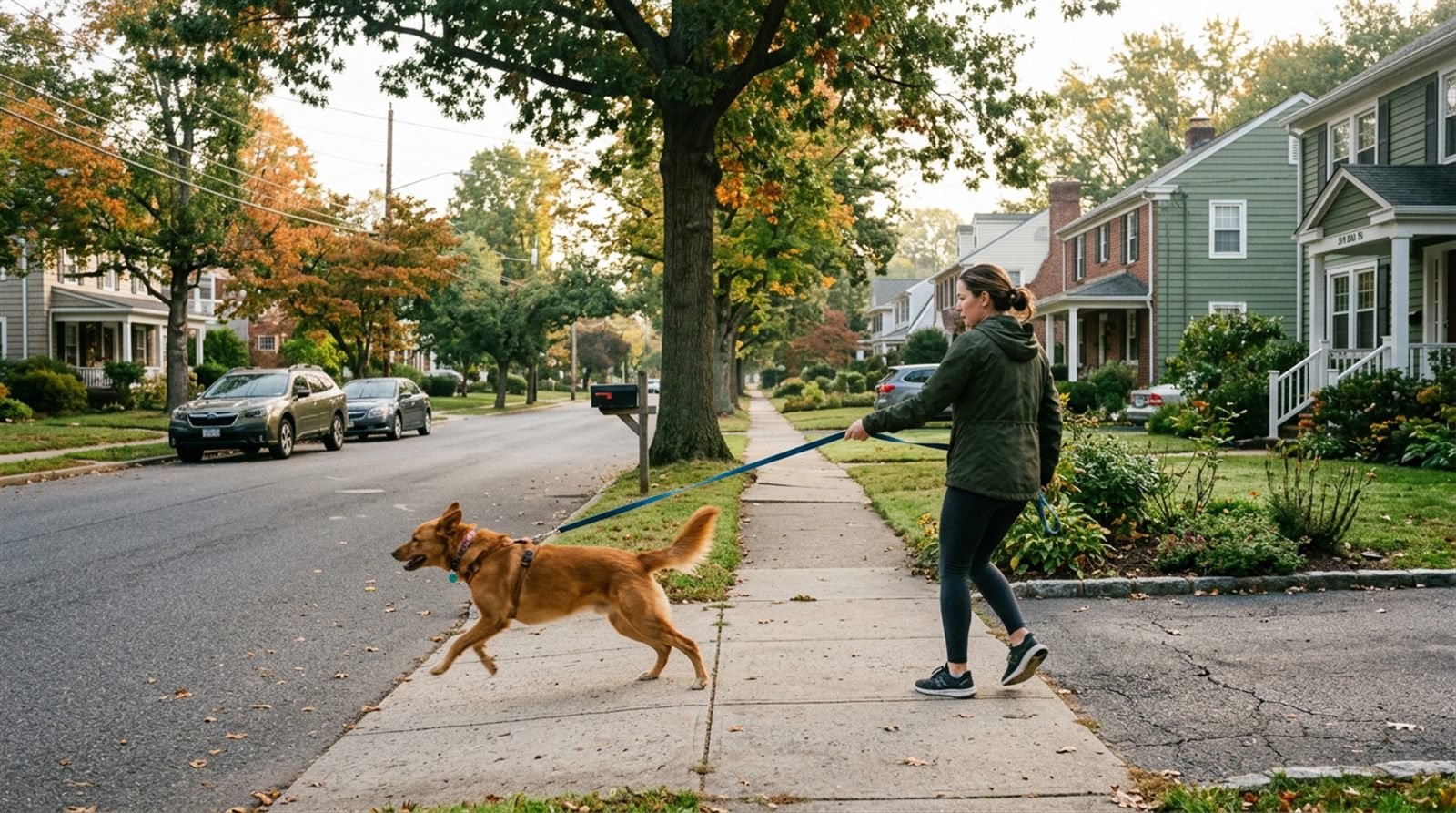
What is actually happening at the end of that leash?
Dogs solve social problems with distance. A dog that is unsure about an approaching dog drifts sideways, slows down, sniffs the ground, arcs around. A confident dog that wants to interact goes and interacts. Both strategies depend on being able to move freely.
Clip on a leash and both disappear. Your dog can see the trigger, cannot leave, cannot approach, and is attached to a human who is now walking straight at the problem. Barking and lunging is what is left — and from the dog's point of view it works, because the other dog nearly always goes past and disappears. The behavior gets rehearsed and reinforced several times a week.
This is why the same dog can be perfectly civil at daycare and a disaster on the sidewalk. It is not a different dog. It is the same dog with its options removed.
Fear or frustration — which one is yours?
The two look similar from behind and need slightly different handling.
- Fear-based: body leans back or low, weight shifted away, tail low, barking has a higher and more urgent tone, and the dog is relieved when the other dog passes. This dog wants more space.
- Frustration-based: body leans forward, tail high and often wagging fast, straining toward the other dog, and the dog is disappointed rather than relieved when it passes. This dog wanted to say hello and could not.
Both respond to the same core plan. The difference is what the reward is: for the fearful dog, distance itself is the reward. For the frustrated dog, calm behavior eventually earning a controlled greeting can be.
Why the two most common pieces of advice make it worse
"Correct him so he knows it is not allowed"
The AVSAB's 2021 position statement recommends reward-based methods only and specifically discourages shock, prong and choke collars. For reactivity there is also a mechanical problem: a dog that gets a sharp correction every time another dog appears learns that other dogs predict discomfort. You can suppress the barking and deepen the fear at the same time, which leaves you with a dog that no longer warns you before it reacts.
"Let them meet, they will sort it out"
On-leash greetings force a head-on approach at close range with no escape route — the exact configuration dogs avoid when left to themselves. For a reactive dog this is a reliable way to rehearse the reaction. The ASPCA's leash reactivity guidance is built around controlled distance, not introductions.
The distance rule that changes walks fastest
Everything in a modern reactivity plan happens at a distance where your dog can still think. That distance has a name — threshold — and finding yours is the single most useful thing you can do this week.
How to find it: spot another dog at a long distance. Offer your dog a piece of something excellent. If your dog takes the food, looks at you, and can still move normally, you are under threshold. If the food is ignored, the body stiffens, or the dog cannot look away, you are too close. Back up until the food works again. That is your working distance today.
It will not be a fixed number. Threshold shrinks when your dog is tired, when the other dog is staring, when the street is narrow, and when it rained and everything smells interesting. Treat it as a reading you take fresh each time, not a rule you memorise.
What a session actually looks like
Ten minutes, three times a week, is more useful than an hour on Sunday.
- Park somewhere dogs pass predictably but at a distance you control — the far edge of a park, a bench across a wide street.
- The moment your dog notices a dog, feed. Not when it barks, not when it looks at you — the instant it clocks the trigger.
- Keep feeding while the dog is visible. Stop when it is gone.
- If your dog cannot eat, you are too close. Move back and try again.
- End while it is still going well.
That sequence is counterconditioning, and the order matters more than anything else: the trigger predicts the food, not the other way round. Reverse it and you teach your dog that food predicts scary dogs.
How long before this gets better?
Mild frustration-based reactivity often improves noticeably in two to four weeks. Fear-based reactivity in a dog that has been rehearsing it for years is a months-long project with a plateau in the middle that makes most people quit. We break the honest timeline down in this guide.
One thing that speeds everything up: stop walking your dog past triggers you cannot manage while you train. Every explosive reaction is a rep in the wrong direction. Drive to a quieter street for a few weeks if you have to.
When to bring in a professional
Book a credentialed behavior professional — a veterinary behaviorist (DACVB) or certified consultant — if there is any bite history, if the reactivity is aimed at people or children, if it appeared suddenly in an adult dog, or if a month of consistent work has changed nothing. Sudden behavior change in particular deserves a veterinary exam first, because pain is a common and badly underdiagnosed cause.
Frequently asked questions
Is leash reactivity the same as aggression?
Usually not. Most leash reactivity is fear or frustration expressed loudly because the leash removes the dog's ability to increase distance or approach. A dog that is calm with other dogs off leash but explosive on leash is almost never aggressive in the clinical sense.
Does leash reactivity mean my dog is dominant?
No. Dominance theory has been rejected by veterinary behavior organisations as an explanation for household dog behavior. Reactivity is an emotional response to a trigger, not an attempt to gain rank.
Should I let my reactive dog greet other dogs on leash?
Generally no. On-leash greetings force a face-to-face approach that dogs would normally avoid, with no option to retreat. For a reactive dog this reliably raises tension and can rehearse the exact reaction you are trying to reduce.
What distance should I keep from other dogs?
Whatever distance lets your dog notice the other dog and still eat, look at you and move normally. That is your working distance. It might be twenty feet or it might be a full block, and it changes day to day.
Sources
- AVSAB — Position Statement on Humane Dog Training (2021)
- ASPCA Professional — Reactive Dogs on Leash (PDF)
- AAHA — Canine and Feline Behavior Management Guidelines (PDF)