Crate Training an Anxious Dog — and When Not To
Advertising disclosure: this article may contain affiliate links. We may earn a commission at no extra cost to you. It never changes our advice. How we fund our work
Crates divide people more than almost anything else in dog care, and the argument usually goes nowhere because both sides are describing different dogs.
For one dog a crate is a bedroom it chooses on its own. For another it is a box it cannot get out of while frightened. The crate is the same; the dog is not.
A crate is only useful for an anxious dog if the dog is already relaxed in it with the door open. Confining a dog that panics does not contain the panic — it adds helplessness to it, and it is one of the most common circumstances in which anxious dogs injure themselves. If your dog is distressed when alone and not already crate-happy, use a dog-proofed room instead and work on the underlying problem.
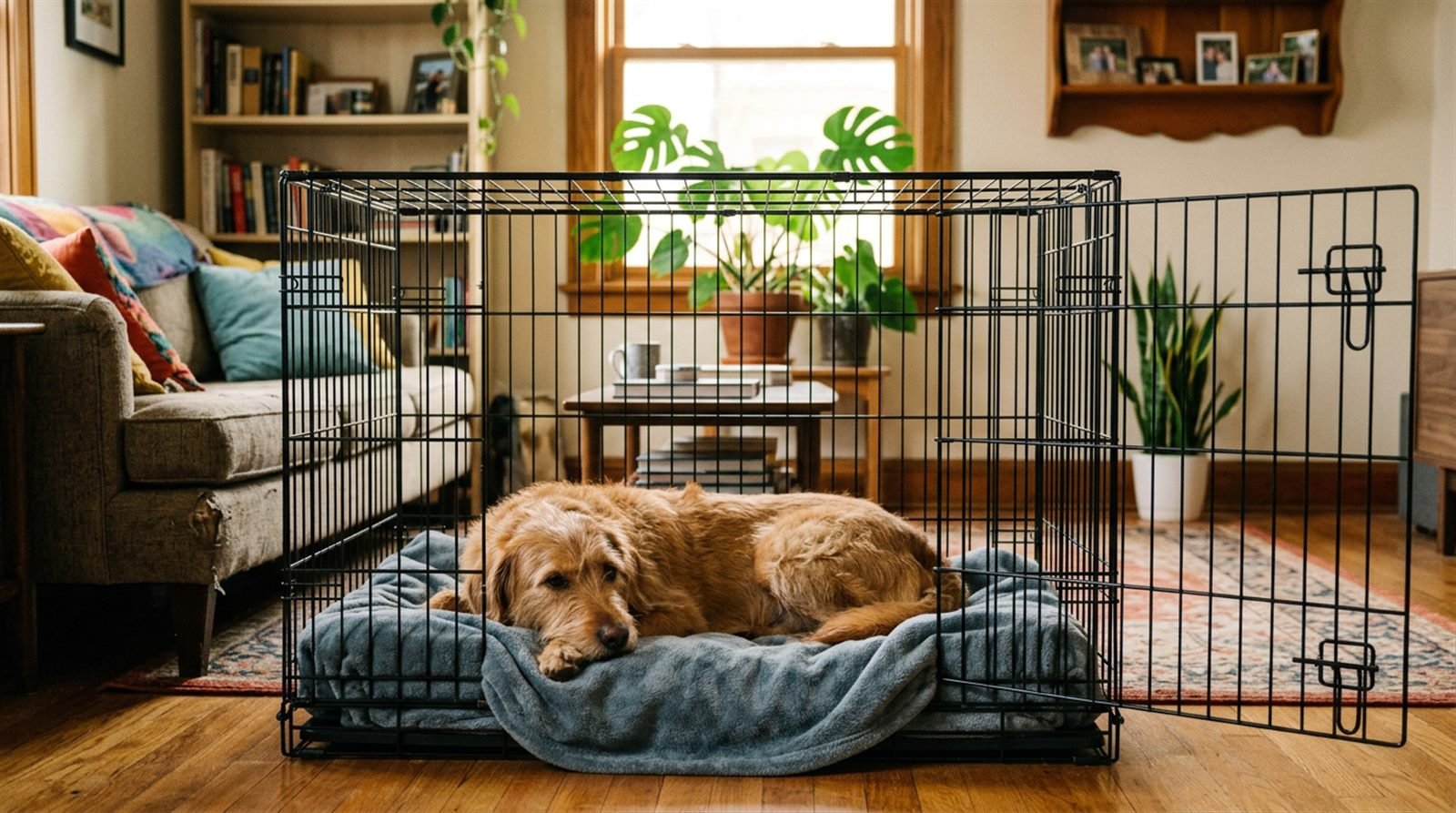
The question to answer before anything else
Not "should I crate my dog" but "is my dog already comfortable in a crate?"
A dog that likes its crate:
- Goes in on its own when nothing is happening
- Lies down properly, hips rolled to one side
- Sleeps in there with the door open
- Does not change when the door closes
A dog that does not:
- Only goes in when food is thrown in
- Sits upright facing the door
- Freezes, pants or drools once the door shuts
- Scratches, chews the bars, or bends the door
If your dog is in the second list, the crate is not currently a safe space and closing the door on it will not make it one.
⛔ When not to crate at all
Do not use a crate for absences if:
· Your dog has ever injured itself trying to get out — bloodied paws, broken nails, damaged teeth, facial abrasions
· Your dog panics when confined, even briefly
· Your dog has bent or damaged a crate door
· You are considering the crate because of destruction while alone, without having addressed why the destruction is happening
That last one is the trap. A crate stops the sofa being destroyed. It does nothing about the fear that was destroying the sofa — and the dog now has nowhere to go with it.
The ASPCA's separation anxiety guidance is clear that confinement can make distress worse rather than better. If your dog is in this category, a dog-proofed room with a baby gate gives you damage control without the trap.
Building a crate a dog actually likes
Nothing here is fast. Rushing is what produces dogs that hate crates.
- Door off, or tied fully open. For the first several days the door does not exist. A door that can swing shut accidentally can undo a week.
- Make it the best address in the house. Comfortable bedding, and food that appears in there for nothing — dropped in as you walk past, several times a day.
- Feed meals inside. Bowl at the back, dog eats, dog leaves. No door, no fuss.
- Wait to be invited. When your dog starts going in by itself and lying down, you are ready for the next step. Not before.
- Close the door for two seconds. Dog inside eating, door closed, door open, dog free to leave. Two seconds. Then three.
- Build up while you stay in the room. Only once minutes are easy do you leave the room, and then only for seconds at first.
The rule that governs all of it: open the door before your dog wants out, never after it asks. Releasing a whining dog teaches that whining opens doors, and it also teaches that being in there is worth complaining about.
Practical details that matter
Size. Big enough to stand up, turn around and lie fully stretched. Bigger is not automatically better for a dog that likes a den, but too small is never right.
Placement. In the room the family uses, not in the laundry. A crate down the hall is isolation with extra steps.
Covering. A cover over three sides suits many dogs; some find it worse. Try it and watch.
Never as punishment. One use of the crate as a consequence undoes weeks of building it as a good place.
Duration. Eight hours crated is a long time for any dog and too long for most. If a full working day needs containment, a dog-proofed room plus a midday break is the better structure.
The alternative most people should use
A dog-proofed room with a baby gate does nearly everything a crate does — limits access, protects your house, keeps the dog somewhere safe — without removing the dog's ability to move. For an anxious dog, that difference is not cosmetic. Being able to move is a large part of what keeps a worried animal from tipping into panic.
Frequently asked questions
Should I crate a dog with separation anxiety?
Only if the dog is already genuinely relaxed in the crate. For a dog that panics, confinement commonly intensifies distress and is a frequent cause of injuries from escape attempts. A crate contains the damage, not the panic.
How do I know if my dog likes its crate?
A dog that likes its crate goes in on its own when nothing is happening, lies down with hips rolled to one side, and sleeps in there with the door open. A dog that only enters when lured, sits upright facing the door, or freezes when the door closes does not like it yet.
Is it OK to crate a dog for 8 hours?
Eight hours in a crate is a long time for any dog and too long for most. If a dog needs containment for a full working day, a dog-proofed room or a pen is usually a better answer, along with a midday break.
My dog injured itself trying to escape the crate. What now?
Stop using the crate for absences immediately and speak to your veterinarian. Self-injury during confinement is a sign of significant distress rather than stubbornness, and it needs a behavior plan and likely professional support, not a sturdier crate.
Sources
- ASPCA — Separation Anxiety
- ASPCA Professional — Treating Separation Anxiety in Dogs (PDF)
- AVSAB — Position statements and public handouts
- AAHA — Canine and Feline Behavior Management Guidelines (PDF)