Dog Anxiety Symptoms: What Stress Actually Looks Like
Advertising disclosure: this article may contain affiliate links. We may earn a commission at no extra cost to you. It never changes our advice. How we fund our work
When a dog growls, everybody notices. The problem is that a growl is not the beginning of anything — it is the sixth or seventh thing the dog tried, after several quieter attempts nobody read.
Learning the quiet ones is the closest thing to a superpower an owner can pick up. It costs nothing, takes about a week of paying attention, and it is the difference between helping your dog early and reacting late.
Dog stress signals escalate in a predictable order: lip licking and yawning, then turning away and freezing, then whale eye and a tucked tail, then growling, and only then snapping. Most owners only recognize the last two. If you learn the first four, you can move your dog away from the problem before it ever has to escalate — which is also how you stop a small worry from becoming a permanent one.
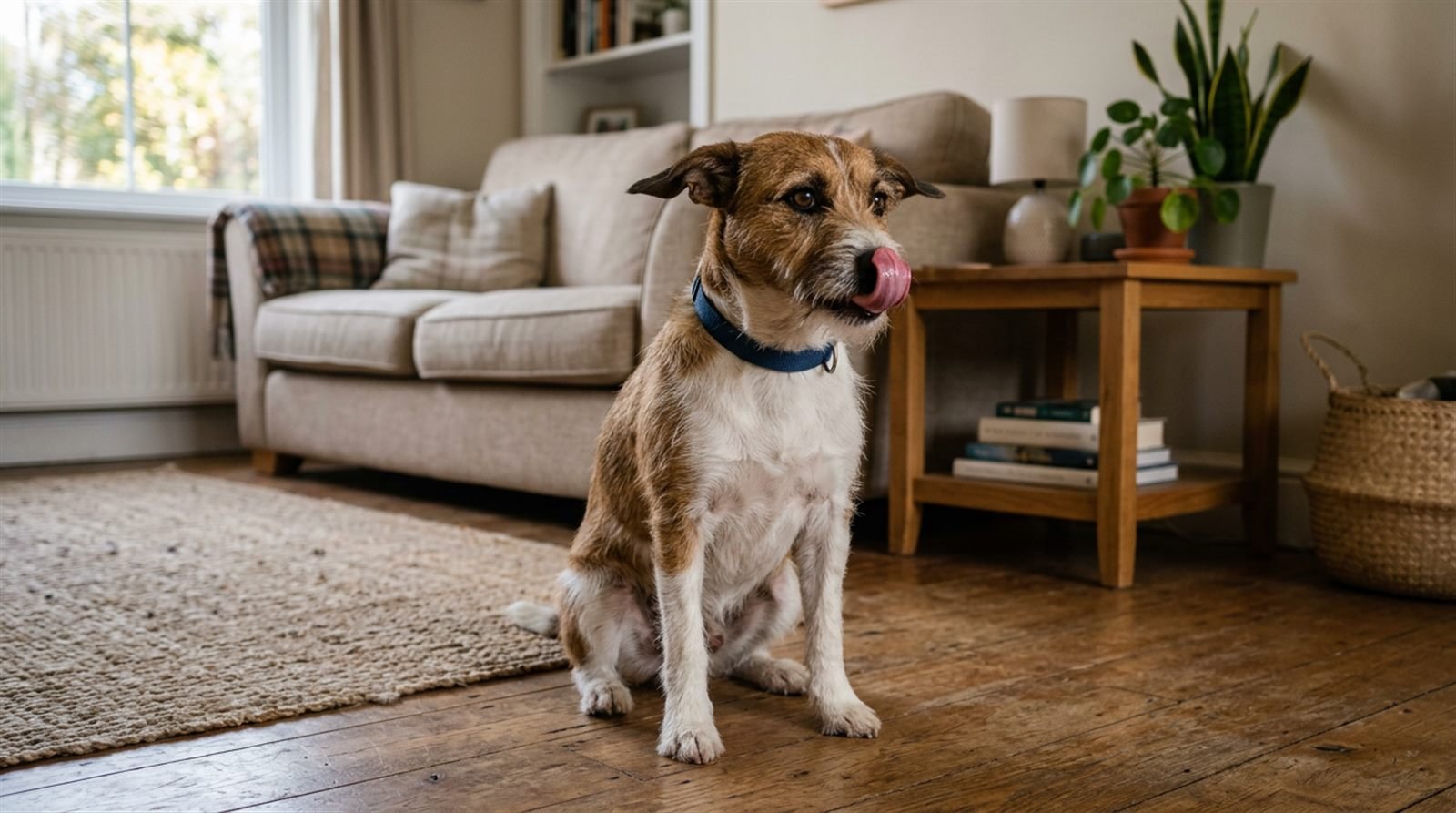
The quiet signals, in the order they usually appear
Lip licking with no food anywhere
A quick tongue flick across the nose when nobody is eating. This is one of the most common and most missed signals in the entire repertoire. Watch for it during hugs, during vet handling, and when a stranger leans over your dog.
Yawning when nothing is tiring
A yawn during a tense greeting or in a waiting room is usually a displacement behavior, not sleepiness. Context tells you which: a yawn on the sofa at 10pm is a yawn, a yawn as a child approaches is a message.
Turning the head or the whole body away
The polite canine way of saying "I would like this to stop". A dog that turns its head away while someone pets it is not being aloof — it is asking, quietly, for a pause.
Freezing
A brief stillness, often for less than a second. This one matters more than the rest because it frequently comes immediately before an escalation. A dog that goes still while being handled or while another dog approaches has run out of quieter options.
Whale eye
The whites of the eyes showing in a half-moon at the corner, usually because the dog is holding its head still while looking sideways at something it does not trust. Common in photographs of children hugging dogs, which is why so many of those photographs make trainers wince.
Tail carriage that is wrong for your dog
Forget general rules — every dog has a neutral. What matters is a tail carried noticeably higher or lower than your dog's own normal. And a wagging tail is not automatically a happy one: high and fast in tight arcs is arousal, not friendliness.
The shake-off on dry fur
A full-body shake when the dog is not wet, usually right after a tense moment ends. It is a reset button, and it tells you the moment before it was uncomfortable.
Louder signals — these mean you missed the earlier ones
- Panting with no heat and no exercise to explain it. Look at the shape too: stressed panting is often shallow and fast with the corners of the mouth pulled back.
- Pacing a repeated route, especially the same line back and forth.
- Refusing food it normally loves. The single most reliable field test you have. A dog that will not eat is a dog over threshold.
- Drooling in a dog that does not usually drool.
- Growling. This is information, not defiance. A dog that growls is warning you, and punishing the growl teaches it to skip the warning next time. That is how dogs get labeled as biting "without warning".
Reading the whole dog, not one part
Single signals mislead. A yawn on its own means very little; a yawn plus a turned head plus a still body means a great deal.
The quickest habit to build is scanning three things at once: the mouth (loose and open, or closed and tight?), the body (wiggly, or stiff?), and the eyes (soft and blinking, or hard and fixed?). A relaxed dog is loose almost everywhere. A worried dog goes tight in several places at the same time.
What to do the moment you spot one
- Add distance. Not a correction, not reassurance — space. Space is what the dog was asking for.
- Let the dog choose. If someone is petting your dog, stop and see whether the dog leans back in. If it does not, it did not want it.
- Never punish the signal. Suppressing a growl removes the warning and leaves the fear. This is the mechanism behind the majority of so-called unpredictable bites.
- Log the trigger. Three or four entries and a pattern usually appears — men in hats, the hallway, being approached while eating.
Once you know the trigger, you have something to work with. That is where counterconditioning comes in.
When the symptoms are medical
Sudden anxiety in an adult dog, especially an older one, deserves a veterinary exam before a behavior plan. Pain is the most under-recognized cause of behavior change in dogs, and hearing loss, vision loss and canine cognitive dysfunction all present as new anxiety. The AAHA behavior guidelines treat medical assessment as part of the workup, not an optional add-on.
Frequently asked questions
What are the early signs of anxiety in dogs?
The earliest signals are small and quiet: lip licking with no food present, yawning when not tired, turning the head away, freezing briefly, and showing the whites of the eyes. These appear long before growling or snapping and are the point at which it is easiest to help.
Is yawning a sign of stress in dogs?
It can be. A yawn with no tiredness around it, especially during greetings, vet visits or hugs, is commonly a displacement signal rather than sleepiness. Context is what separates the two.
Why does my dog shake like it is wet when it is dry?
A full-body shake-off on dry fur usually marks the end of a stressful moment. Dogs often do it after a tense greeting, after being released from a hug, or when a trigger has passed. It is a reset, and a useful clue that something was uncomfortable.
Does a wagging tail mean my dog is happy?
Not on its own. A tail held high and wagging fast in short arcs often signals arousal rather than friendliness. Read the whole dog: loose body and soft face means relaxed, stiff body with a high tail does not.