How to Keep a Dog Calm With Holiday Guests in the House
Advertising disclosure: this article may contain affiliate links. We may earn a commission at no extra cost to you. It never changes our advice. How we fund our work
The oven has been on since seven, there are twelve coats on the bed, and somewhere under the dining table is a dog who didn't sign up for any of it. Three of the guests are children, and someone just set a plate of turkey skin on the coffee table.
Holiday guests stress a lot of dogs, and the fix isn't what most people reach for. It's not obedience. It's logistics.
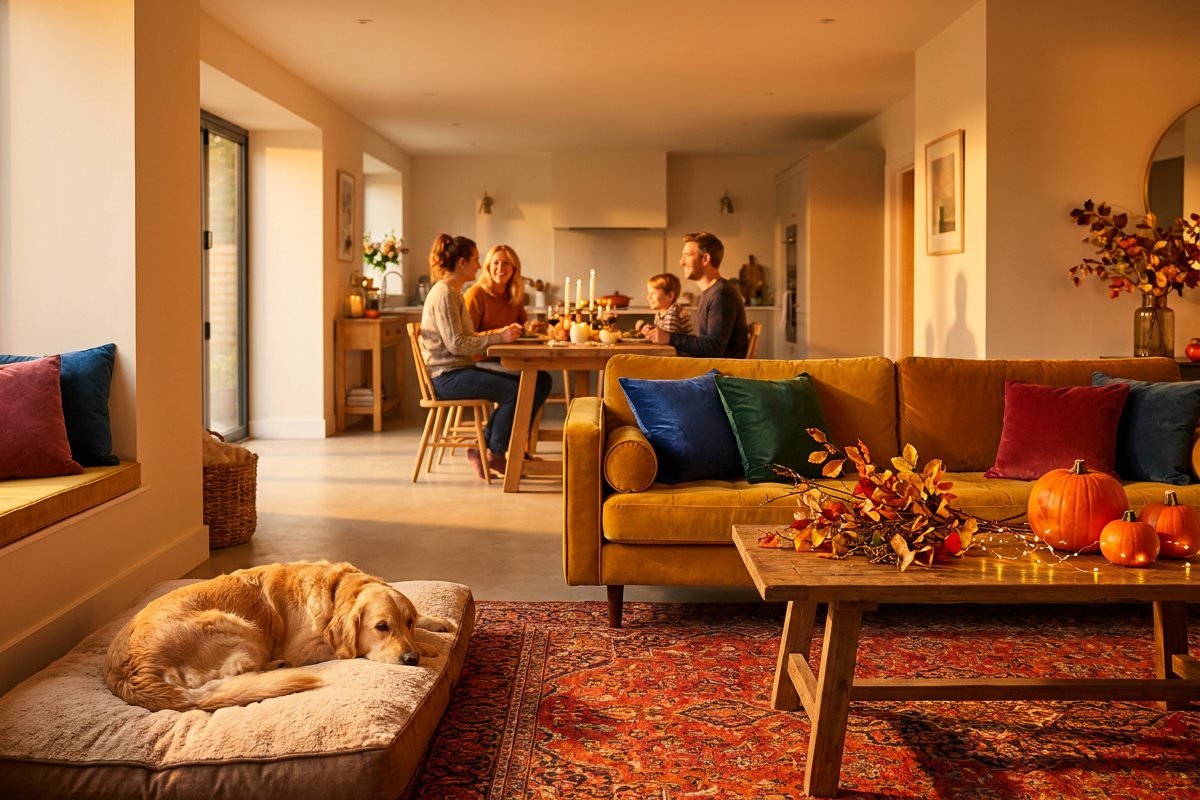
A house full of people is a common stress trigger for dogs, and the holiday version adds strangers, noise, and food at nose height. The realistic goal for Thanksgiving or Christmas is management, not last-minute training: decide where the dog will be, tell your guests the rules, and keep the feast off the floor. The food is the part that sends dogs to the emergency vet.
Start with the honest part: you're managing, not training
Two weeks before Thanksgiving is not enough time to change how your dog feels about strangers. Real behavior change happens through counterconditioning, which takes weeks of short sessions with the trigger kept faint. A living room with fourteen people in it is the opposite of faint. That's a January project.
What you can do in two weeks is arrange the day so your dog never has to cope with more than he can handle. None of that teaches him anything, and none of it has to. It gets everyone through the day with no bite, no vet visit, and no dog who spends December worse than he started.
Two weeks out: the three things worth doing
Decide now where the dog will be
There are three options worth considering. The dog who loves people stays out, with someone assigned to him. The dog who gets overwhelmed goes to a quiet room with the door closed before the first car pulls in. And the in-between dog does a short greeting on leash, then goes to his room once the novelty has worn off.
Pick based on the dog you have, not the one you'd like to show your relatives. Set the room up now, so it isn't new on the day: his bed, water, something to chew, a fan or radio for background sound. Feed a few meals in there this week. An afternoon in a bedroom while the house is full and you're home is not the same thing as being left alone, so a dog who has never shown separation anxiety signs is unlikely to develop them here.
Check the ID tag and the microchip details
On Thanksgiving the front door gets opened over and over, mostly by people who don't know your dog bolts. This week, confirm the phone number on the tag is current, then check the microchip registration at the AAHA microchip lookup. Registrations lapse when people move.
Tell your guests before they arrive
Adults will feed a dog turkey skin because he's cute. Kids will hug him because nobody told them not to. A message in the family group chat a few days ahead handles most of it. Paste this:
"Quick note about [dog]: please don't feed him anything from the table, even a bite. Chocolate, anything sugar-free, grapes, onion, and bones are genuinely dangerous for him. When you come in, ignore him for the first minute and let him come to you. Kids: no hugging, no climbing, and leave him alone when he's eating or sleeping. Thank you!"
The sugar-free line matters more than it looks. Xylitol, the sweetener in sugar-free gum, candy, and some peanut butter, is toxic to dogs even in small amounts, according to both the ASPCA and the FDA.
The day itself: a timeline
The plan assumes a dog who does best in his own room; if yours stays out, he does the same steps on a leash at your side.
| When | What you do | What the dog is doing |
|---|---|---|
| 2 weeks before | Choose the dog's spot, set up the quiet room, update the tag and chip, message the guests | Learning the room is boring and good things happen there |
| Morning of | A longer walk than usual, breakfast as normal, then bed, water, and a chew go into the room | Tired, fed, and familiar with where he'll spend the afternoon |
| 1 hour before | Dog goes to his room before the first car arrives; calming chew, if any, was given earlier | Settling with a chew before the noise starts |
| Arrivals | Doorbell muted or a note on the door; guests come in, ignore the dog, sit down first | Not being greeted, which is the whole point |
| Dinner | Dog in his room or on a mat well away from the table; one adult owns the dog, not the hosting | Working on a frozen lick mat instead of watching plates |
| After dessert | Trash lidded and outside, counters cleared, a five-minute walk with one calm person | Nose down in the yard, out of the crowd |
| Next 2–3 days | Short, predictable routine; no visitors, no new places | Sleeping it off, and maybe a little clingy |
The frozen lick mat in the dinner row does more work than anything else on that list. Licking is slow, absorbing, and self-soothing, and a mat that takes a while to finish covers the loudest stretch of the meal. Enrichment is one of the things I compared in calming solutions for anxious dogs.
If you use a calming chew, it goes in well before the first knock, not when the doorbell rings. Whether they help at all, and for which dogs, is in do calming treats actually work.
When the doorbell rings
For most dogs the doorbell is the loudest cue of the day, and on a holiday it goes off again and again for the first hour. Mute it, or tape a note over it asking people to text when they're outside. Then have guests come in and sit down before anyone acknowledges the dog. Six people bending over him at the door is the worst possible start.
If he barks at every knock the rest of the year too, the doorbell is only one of many triggers. The full room-by-room approach is in my dog barks at everything.
Holiday food: what to keep off the floor
Behavior problems on Thanksgiving are unpleasant. Food problems end at the emergency clinic. The ASPCA and Pet Poison Helpline both publish holiday lists, and the same items come up every year.
| Food | Why it's a problem | What to do |
|---|---|---|
| Chocolate | Contains methylxanthines, which are toxic to dogs; the darker and more bitter, the higher the risk (Merck Veterinary Manual) | Baking chocolate and dark bars on a high shelf; call Poison Control for any amount |
| Xylitol (sugar-free gum, candy, some peanut butter) | Toxic even in small amounts, and hides in "sugar-free" products (ASPCA, FDA) | Read labels on anything sugar-free; purses and coats up off the floor |
| Grapes and raisins | Linked to kidney injury; no safe amount is known (ASPCA) | Fruit bowls, trail mix, and raisin stuffing stay off low tables |
| Onion and garlic | Damage red blood cells; cooked, raw, and powdered all count (ASPCA) | No stuffing, gravy, or casserole leftovers; they're in nearly all of it |
| Raw bread dough | Rises in the warm stomach and releases alcohol as it ferments (ASPCA) | Proof dough on the counter, never a low table; watch for a swollen belly |
| Cooked poultry bones | Cooked bones splinter; choking and perforation risk (ASPCA) | The carcass goes into a lidded outdoor bin the same night |
| Fatty leftovers and turkey skin | Can trigger pancreatitis; signs can show up as late as four days after (Pet Poison Helpline) | No skin, drippings, or gravy; plain meat only, and only a little |
| Alcohol | No amount is safe for a dog; unattended cups and spiked eggnog are the usual route (ASPCA) | Drinks on high tables, never on the floor by the couch |
| Macadamia nuts | Cause weakness, vomiting, tremors, and a raised temperature (ASPCA, Pet Poison Helpline) | Nut bowls and macadamia cookies off the coffee table |
The pattern is height. Almost everything on that list becomes safe once it's above a dog's reach and the trash has a lid. A small dog like a Yorkie can't reach the counter, but a coffee table, a child's plate, and a purse by the door are all at eye level.
Kids and dogs in the same room
Picture the bite you're trying to prevent: a child and a dog who both had somewhere else they'd rather be. The rules are short. One adult is assigned to the dog for the entire visit, and that adult isn't cooking. No child is ever alone with the dog, not for a minute, not "he's fine with kids." No hugging, no climbing on him, no touching while he's eating or sleeping. If a child can't follow those rules yet, the dog goes to his room.
A growl is information, not disobedience. Correcting the growl takes away your dog's way of saying "too much," and a dog who has been punished for warning is a dog who's closer to biting without one. That is the position of the American Veterinary Society of Animal Behavior in its 2021 statement on humane training: punishing warning signals reduces future warnings and can raise the risk of a bite that arrives with none.
The dog who hides, and the dog who growls
Both are telling you the same thing at different volumes. Long before a growl, most dogs run through the quiet signals: lip licking with no food around, yawning when nothing's tiring, turning the head or the whole body away. The full list is in dog anxiety symptoms.
The dog who slips off to the bedroom on his own has found the solution by himself. Let him. Don't send a nephew to fetch him. The dog who growls has run out of quieter options and is asking for the same thing, just louder. Neither one is being rude. Both are asking to leave, and the answer to both is yes.
After everyone leaves
The part nobody warns you about: the day after can be worse than the day itself. A dog who held it together through eight hours of strangers doesn't reset the moment the door closes. He wakes at 2 a.m. and barks at nothing. He eats less. He follows you into the bathroom. None of that is new anxiety. It's a nervous system that hasn't come back down yet.
The fix is boring on purpose. For two or three days: same walk, same times, same meals, no visitors, no new places. If he's glued to your leg, let him be. A day or two of shadowing after a big event is different from the everyday version, covered in why does my dog follow me everywhere. If the sleep or appetite hasn't come back within a week, mention it to your vet.
New Year's Eve brings a different problem, noise instead of people, and that deserves its own plan.
Red flags: when to call for help
☎️ Call Animal Poison Control now if your dog ate any of these, before symptoms appear:
- Chocolate, in any amount
- Anything labeled sugar-free, or anything that might contain xylitol
- Grapes or raisins
- Onion or garlic in quantity, including stuffing and gravy
- Raw bread dough
- Alcohol
- Macadamia nuts
- A swallowed bone
ASPCA Animal Poison Control: (888) 426-4435, 24 hours a day, 365 days a year.
Pet Poison Helpline: (855) 764-7661, 24 hours a day.
🚨 Emergency vet signs
- Repeated vomiting
- Trembling or a seizure
- A swollen, hard belly
- Retching without bringing anything up
- Sudden weakness or collapse
- Pale gums
- Diarrhea or a painful belly in the days after fatty food: pancreatitis can show up as late as four days later, per Pet Poison Helpline
Save both numbers in your phone now.
Frequently asked questions
Should I put my dog in another room when guests come over?
If your dog gets overwhelmed by a crowd, yes, and it's kinder than making him cope. Set the room up days ahead with his bed, water, and a long-lasting chew, keep it away from the front door, and check on him every hour or so. A dog who greets happily and then settles can stay out. The room is for the dog who can't.
Why does my dog hide when people come over?
Hiding tends to mean the room feels like too much: new smells, loud voices, hands reaching down. It's a polite exit, not a snub. Let him go, don't send guests to coax him out, and make sure the spot he picked is actually quiet. If hiding is new for him, or comes with shaking or refusing food, mention it to your vet.
Is it OK to crate my dog during a party?
Only if he already loves the crate: goes in on his own, sleeps there with the door open, doesn't change when it closes. Then put it in a room away from the guest corridor, not in the hallway. A dog who merely tolerates the crate will do worse in it with a party outside. Our crate guide covers how to tell the difference.
My dog growled at a guest — what should I do?
Calmly add distance: walk the dog away, or ask the guest to step back, and don't scold. The growl told you the situation was too much before a bite did. Afterward, think about what came right before it, a hand over the head, a child leaning in, a plate nearby, and keep the dog out of that situation for the rest of the visit.
What Thanksgiving food can dogs actually eat?
A few bites of plain cooked turkey, with no skin, bones, or seasoning, is fine for most healthy dogs. Plain sweet potato with no sugar, butter, or marshmallows is too. Keep portions small and skip anything with onion, garlic, gravy, or stuffing. If your dog has a sensitive stomach or a history of pancreatitis, skip the table entirely.
Sources
- ASPCA — Thanksgiving Safety Tips
- ASPCA — Holiday Safety Tips
- ASPCA — People Foods to Avoid Feeding Your Pets
- ASPCA — Animal Poison Control Center
- Pet Poison Helpline — Thanksgiving Pet Safety
- Pet Poison Helpline — Xylitol
- Pet Poison Helpline — Chocolate
- Pet Poison Helpline — Bread Dough
- Pet Poison Helpline — Macadamia Nuts
- FDA — Paws Off Xylitol; It's Dangerous for Dogs
- Merck Veterinary Manual — Chocolate Toxicosis in Animals
- AVSAB — Humane Dog Training Position Statement (2021, PDF)
- Texas A&M Vet Med — Introducing Pets to Guests
- AAHA — Pet Microchip Lookup