Why Is My Senior Dog Restless at Night? What His Nights Are Telling You
Advertising disclosure: this article may contain affiliate links. We may earn a commission at no extra cost to you. It never changes our advice. How we fund our work
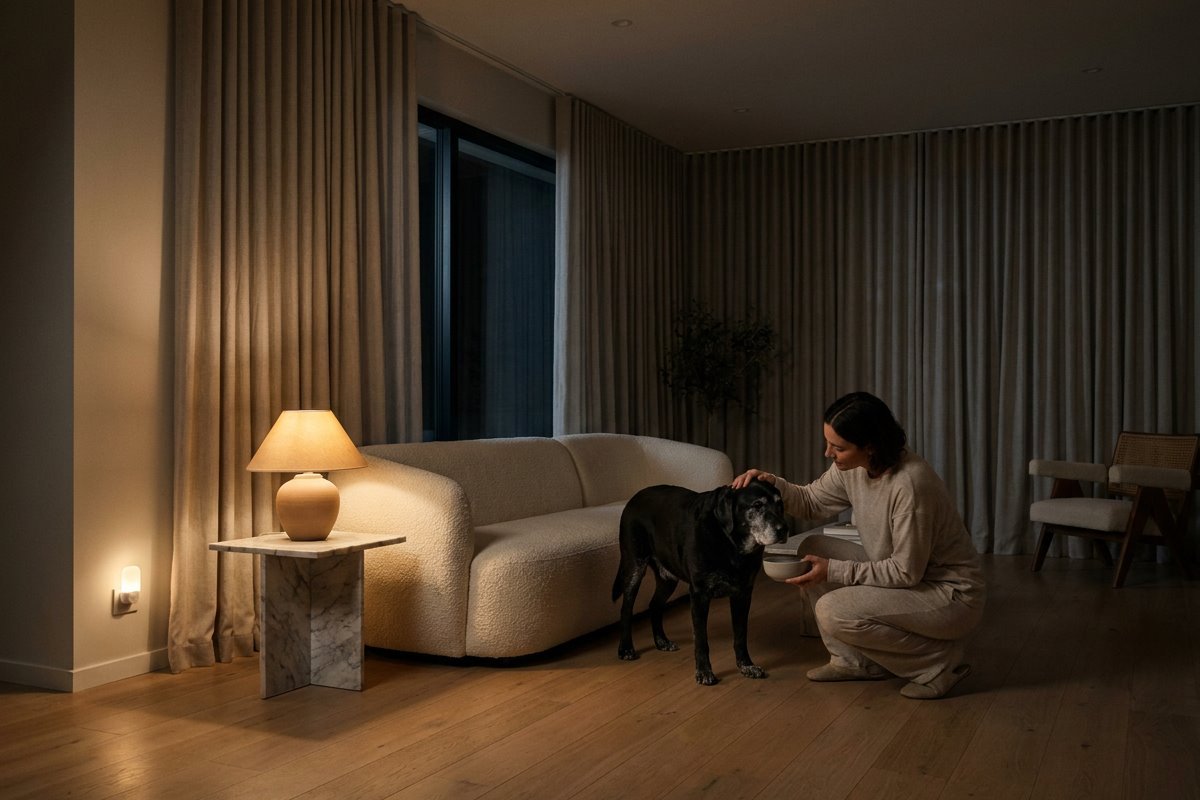
The most common reasons a senior dog is restless at night are pain, needing to go out, and cognitive dysfunction, with heart, kidney, and vision problems close behind. The pattern of his night is the clue: when it starts, what he does, and what settles him. A few signs, like labored breathing or a hard, swollen belly, are an emergency, not a wait-and-see.
It's 2 a.m. and you hear the nails on the floor again. Around the bed, down the hall, back. He lies down with a sigh, and forty seconds later he's up. A tired old dog who can't stay asleep, and an owner who can't either.
A restless night isn't one problem; it's a handful of different ones that look the same in the dark. Each leaves its own pattern, and the pattern is what your vet needs from you.
Restless nights in older dogs: what the newest research shows
In August 2026, The Veterinary Journal published an online survey from the University of Adelaide in which owners of 205 dogs aged eight and older described their dogs' sleep. One caution: owners reported everything; nothing was measured. Even so, the picture is consistent.
More than half of the dogs were reported as most restless between 2 and 5 a.m. The more severe a dog's cognitive dysfunction, the more trouble owners reported getting him to sleep and keeping him asleep, and the more often he peed or pooped indoors at night. Total sleep across the day didn't differ significantly, but the more impaired dogs were reported sleeping less at night and more by day. There was also a trend, not a firm finding, toward restlessness starting earlier, in late afternoon and early evening, as the condition advanced. Bumping into objects and responding less to sounds were reported more often in the severe cases.
That last point matters: a dog who bumps into furniture at night and ignores his name isn't always confused. He may simply see and hear less.
A smaller 2023 study wired dogs up. Using polysomnography on 28 dogs, researchers found that dogs with higher dementia scores spent less time in both NREM and REM sleep. These dogs don't only wake more; the sleep they get is shallower.
Read the pattern: what each kind of night can point to
None of this is a diagnosis. It turns "he's up all night" into something your vet can act on.
| What his night looks like | It can point to | First step |
|---|---|---|
| Wakes at the same hour and heads to the door | Bladder, kidneys, or bowels | Later last trip out; ask for a urine test |
| Can't get comfortable, gets up soon after lying down | Pain, often arthritis | Film it; book a pain check |
| Sleeps all day, paces or stares at walls at night | Cognitive dysfunction | Daytime activity and light; screening questionnaire |
| Pants or coughs while resting | Heart or breathing | Count his sleeping breaths; vet visit soon |
| Drinking and peeing much more | Kidneys, or a hormone problem like Cushing's | Measure his water; senior blood panel |
| Started after a new medication | Side effect | Call the vet before changing anything |
| Started after a change at home | Stress | Restore the old routine; sleep nearby |
| Worse only in the dark | Vision | Night-light; ask for an eye exam |
The most likely causes in senior dogs
Pain that shows up after lying down
Arthritis is the quiet one. A dog with sore hips rarely limps or cries; he just can't find a position that doesn't ache after twenty minutes. The AAHA pain guidelines treat chronic pain as something to look for in every older dog, and night is when it has nothing to compete with. Stiffness that's worst right after he gets up leans toward pain; telling age from ache is covered in signs your dog is slowing down.
Cognitive dysfunction and "sundowning"
Canine cognitive dysfunction is the dog version of dementia. A flipped sleep-wake cycle is one of its clearest signs, and the late-afternoon unease called "sundowning" in people shows up here too: a dog who gets clingy as the light fades, then wanders, stares, or stands at the wrong side of the door at night. The full checklist, diagnosis, and treatment are in dog dementia signs.
Needing to go out: bladder, kidneys, thirst
A dog who wakes at the same hour and walks to the door isn't restless; he's polite. Aging kidneys concentrate urine less well, so he drinks more and produces more. A bladder infection makes him feel he needs to go when he barely does. Cushing's disease, a hormone condition VCA describes as common in older dogs, adds heavy thirst, a pot belly, and a big appetite. All of these start with a urine sample and a blood panel, not a later bedtime.
Heart and breathing
Fluid backing up into the lungs makes lying flat uncomfortable, so a dog with early heart failure gets up, sits, shifts, and sometimes coughs, especially at night and first thing in the morning. VCA lists a soft cough, faster breathing at rest, and tiring on walks among the early signs of congestive heart failure. Small breeds are prone to valve disease, and often the first thing an owner notices is a dog who won't stay down.
Fading eyes and ears
A dog who sees poorly in dim light loses his landmarks after the lamps go off. He bumps a chair, startles, and can't find his way back to bed. A dog who hears less wakes disoriented. Both look like confusion, and both are easy to check in a routine exam. If the restlessness is worse in the dark and fine with a light on, say that first.
Medication side effects
Steroids, some pain medications, and several other drugs can cause thirst, restlessness, or agitation. If the bad nights began within a few weeks of a new prescription or a dose change, that timing is a clue your vet needs. Don't stop or adjust anything on your own; just call.
Anxiety and changes at home
Older dogs handle change worse. A move, a new baby, a family member gone, even rearranged furniture can unsettle a senior who relied on knowing where everything was. If the nights fell apart right after something changed, the household is the first place to look.
Panting while he rests
A dog breathing hard on a cool night, lying down, with no exercise to explain it, is showing you something, and it's more often medical than behavioral. The full breakdown is in dog panting at night.
How to count his sleeping breathing rate
This is the most useful thing you can measure at home, and it takes one minute. VCA gives the range: a normal resting or sleeping breathing rate is 15 to 30 breaths per minute. A rate that stays above 30 is abnormal and worth a call to your vet.
- Wait until he's deeply asleep, not dozing. Not after a walk, not on a hot day.
- Watch his chest or flank. One rise and fall is one breath.
- Count for 30 seconds and double it, or count a full 60 seconds if you can.
- Write the number down with the date and time.
- Repeat on a few different days, so you know his normal and can spot a change.
A single high reading on a warm night means little. A number that sits above 30 on several nights, or climbs week over week, is something your vet will want to see.
Night red flags: go to the emergency vet
🚨 Tonight, not in the morning
- Pale, white, or bluish gums
- Working hard to breathe, or a resting rate that stays above 30
- Coughing with labored breathing
- Swollen or hard belly with unproductive retching and restlessness (bloat)
- Collapse or sudden weakness
- A seizure
- Sudden head tilt, flicking eyes, circling, or falling
- Straining to pee with nothing coming out
- Repeated vomiting or diarrhea
- Crying out when touched
- You think he swallowed human medication
Gastric dilatation-volvulus, or bloat, where the stomach fills with gas and twists, is fatal within hours without surgery. The ACVS describes the classic picture as a restless, distressed dog who retches without bringing anything up. If that's what you see, drive.
A calmer night, step by step
These support whatever your vet finds. For a dog in pain, none of them will work until the pain is treated.
In the afternoon
Nights are built during the day. A dog who sleeps from breakfast to dinner has no sleep left by midnight. Daytime movement helps nights: a slow sniff walk, a food puzzle, a few minutes of easy cue practice. Keep him in natural daylight where you can; light sets the body clock, and his is drifting. Feed dinner and walk at the same time every day.
Before bed
Make the last trip out as late as you reasonably can, and make it a real one, with time to fully empty. Put water within a few steps of his bed. Leave one dim night-light on for the route to the door. Keep the room cool. A steady, quiet background sound covers the noises that wake him. If he's been sleeping in another room, move his bed beside yours, or use a pen so he can't wander into trouble. For tonight, more padding beats less. And block the stairs at night, for the reasons in dog struggling with stairs.
At 2 a.m.
When he wakes, meet the need and nothing more. If he wants out, take him out, quietly, low light, no chatter, and straight back to bed. If he's confused, guide him to his bed with a hand on his side and lie back down. What you're avoiding is turning the small hours into attention time; a dog learns fast that 2 a.m. is when the good stuff happens. And never scold him. He isn't doing this to you, and a confused or aching dog who gets yelled at just adds fear to the list.
What not to give him in the middle of the night
Never a human pain reliever. The FDA warns that ibuprofen, acetaminophen, naproxen, and aspirin can cause stomach ulcers, kidney failure, and liver damage in dogs. If you think he's in pain tonight, the answer is the emergency line, not the medicine cabinet.
Melatonin, sedatives, anti-anxiety medications, and a prescription drug for cognitive dysfunction all exist, and any of them may be right for your dog. But only with your vet, at an amount your vet sets, because each can interact with something else he's on, and some human melatonin products contain xylitol, which is toxic to dogs. Don't combine calming products, supplements, or leftover prescriptions on your own. Two mild things can add up to a dog who can't stand.
When you're the one not sleeping
Weeks of broken sleep wear a household down, and a tired owner makes worse decisions for the dog. If there are two adults, take turns: one night on, one night off, with the off person behind a shut door. Sleeping near him usually cuts the pacing more than a gate on the other side of the house, because half of what he's looking for at night is you.
And it's fine to tell your vet, in those words, that the family isn't coping. That's clinical information. It changes how fast your vet moves and what options get offered.
What to tell your vet
Three things, written down, do more than a general "he's restless."
- When it starts and how long it lasts. The hour he first gets up, whether it's the same hour each night, and when he finally settles.
- What he does. Goes to the door, circles the bed, stares, whines, drinks, paces the same loop. A 30-second phone video beats any description.
- What changed recently. New medication, a dose change, new food, a move, a new pet.
Add his sleeping breathing rate. If you've noticed daytime changes too, the two-week log in dog dementia signs gives your vet the whole picture on one page.
Frequently asked questions
Is it normal for old dogs to be restless at night?
Common, yes. Normal, no. Older dogs nap more by day and may need one extra trip out, but a dog who can't settle, paces, or whines most nights is telling you something: pain, a bladder or kidney problem, or cognitive dysfunction are the usual suspects. All three can be helped, so it's worth a vet visit rather than a shrug.
Why does my senior dog wake up at 3 a.m.?
A 2026 owner survey of 205 older dogs found more than half were reported as most restless between 2 and 5 a.m. What he does when he wakes is the clue. Heading for the door can suggest a bladder or bowel need; getting up and lying down again can suggest pain; wandering, staring, or standing in corners can suggest cognitive dysfunction.
Is my old dog restless because he's dying?
Usually not. Restless nights are far more often pain, a full bladder, or an aging brain, and each of those has options. That said, a senior who stops eating, can't get comfortable anywhere, or seems distressed around the clock deserves an honest quality-of-life conversation with your vet. Asking the question early is a kindness, not a betrayal.
Should my senior dog sleep in my bedroom?
If it helps him settle, yes. Many older dogs, especially those with fading sight or hearing, rest better when they can smell and hear you nearby, and you'll notice a real problem sooner. Put his bed on the floor beside you rather than on the bed, so he doesn't jump, and block the stairs if his room is on another floor.
Can I give my old dog melatonin?
Only if your vet says so. Melatonin is used in dogs for some sleep and behavior problems, but it can interact with other medications and some human products contain xylitol, which is toxic to dogs. Never give a human sleep aid or pain reliever on your own. Ask your vet whether it suits your dog and what form and amount are safe.
Sources
- The Veterinary Journal — Taylor, Tuke & Hazel (2026), owner-reported sleep in senior dogs
- PMC — Polysomnography in dogs with cognitive dysfunction (2023)
- VCA — Home Breathing Rate Evaluation
- VCA — Congestive Heart Failure in Dogs
- VCA — Cushing's Disease in Dogs
- VCA — Melatonin
- AAHA — 2023 Senior Care Guidelines for Dogs and Cats
- AAHA — 2022 Pain Management Guidelines for Dogs and Cats
- ACVS — Gastric Dilatation-Volvulus
- ACVS — Osteoarthritis in Dogs
- FDA — Get the Facts About Pain Relievers for Pets